SOCIOTECH BBL FACILITATOR: Charles Bisimwa
Charles says…
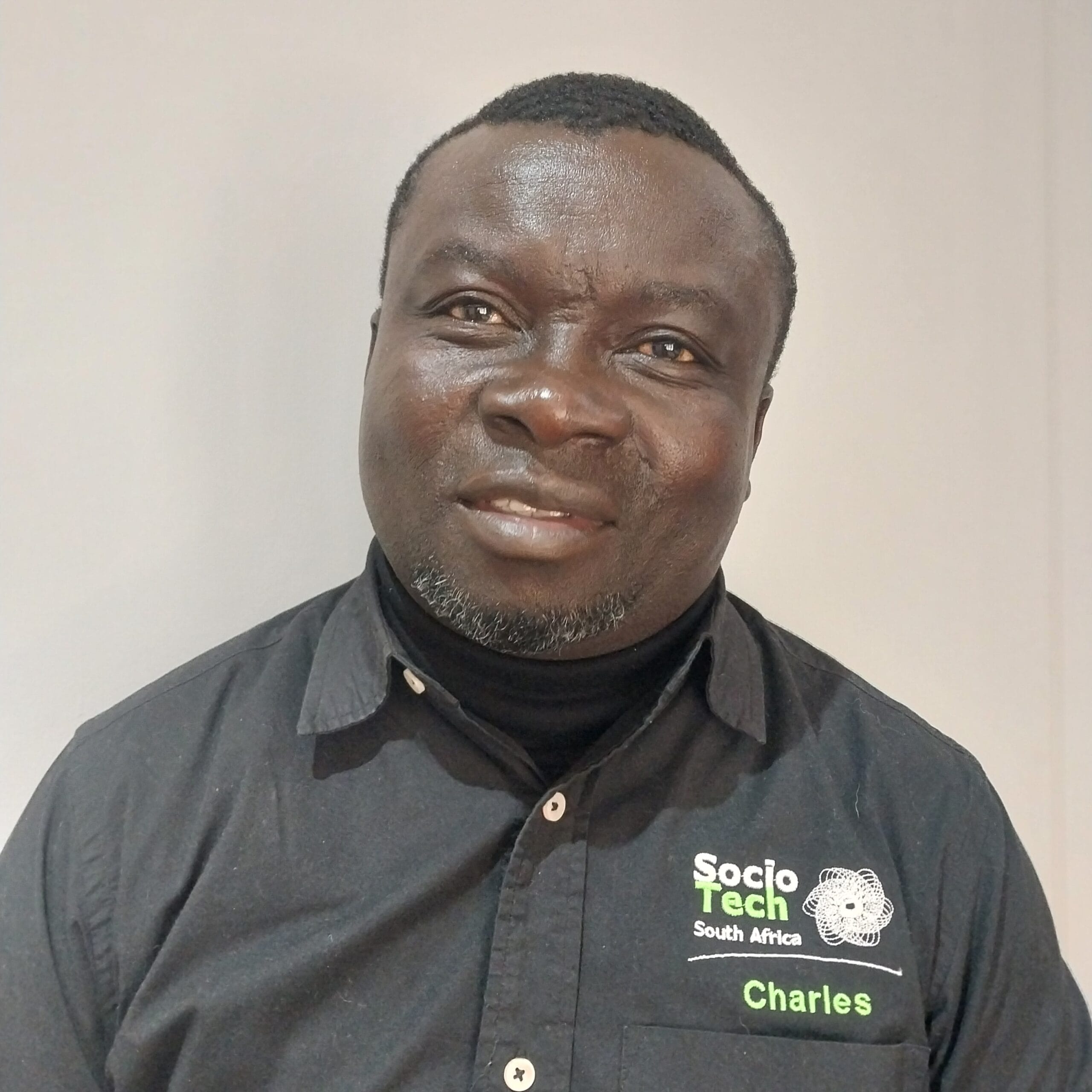
Working at SocioTech fulfills me. I am living the life that I ardently wished for, but that I thought might never be possible. Before I got this job, I was working in hotels, and that was okay, but it didn’t satisfy my soul. This is the field that I always wanted to work in. I remember being a kid in high school and having my older brother ask me what I was going to do with my life. Even then, I knew. I immediately replied that I wanted to work in rural development. That passion was always in me. My goal was always to empower others.
At SocioTech I have been given the opportunity to use the development skills that I studied for. I have been in South Africa for almost 22 years, but prior to leaving my home country of the DRC, I was halfway through a degree in rural development at the University of Bukavu. When I arrived in South Africa, my intention was to continue my studies, but I discovered that UNISA doesn’t offer that exact degree, focusing specifically on rural development. They did offer a general undergraduate community development course, so that is what I signed up for. While I was studying, I sometimes worried that no one would think I was a suitable person to work within South African communities, but God had a plan for me, and through Him I was introduced to SocioTech. I am finally where I was meant to be. Many people would say that this job is stressful, but my stress levels have declined, because I am teaching what God has put in me. I am living out that plan that I developed as a teenager.
The early years in South Africa were difficult – I spent years selling on the streets – but they have added real life, practical experience of social and economic difficulties, which allow me to relate to others who are going through tough times. I think that process has made me a better development facilitator, both in my job and within my family and my broader community. When I meet new arrivals within the refugee community, I tell them my story and it plants a seed of hope. When I work with SocioTech participants all across South Africa, I always present myself to them. I share my journey. I tell the story of what God has allowed me to achieve.
I know that hope is not easy to muster in difficult times. That is one of the many reasons I love the MyFood program. Within the very first three-hour session of MyFood, a person can be in production. That allows people to dare to hope, because they see results. We teach people to farm God’s way, using organic cultivation and pest management methods. Not only are these inexpensive and health-giving, but also, we aren’t making unrealistic assumptions about what inputs participants can afford. This way they can start small with what they have. Starting to see results is the best form of motivation and our careful, consistent mentoring and monitoring allows results to show quickly and improve over time.
I love it when I can see participants changing their outlook. When they start to develop the self-belief that allows them to work for themselves. Recently a man in Northwest Province said to me that he “went into his first SocioTech meeting unemployed, and came out two hours later as a businessman with courage, confidence and a plan of action.”
Teaching people and giving them the tools to control success or failure is a glorious experience. How to save money. How to create a personal budget. How to determine what they need or do not need to buy. Seeing the importance of a side hustle, and eventually building up a family business. It is all so satisfying. Being there for the good times and the difficulties is also important. Patience is an essential life skill. I tell them that they must give their dreams time. It is about eating the elephant steadily over a long time. It is about knowing that some portions will be bigger than others. Sometimes there will be big successes. Sometimes progress will be slow, but stick to the plan, be disciplined, and just keep going.
I live by the principles I teach others. I funded my university studies working on the streets and saving hard, so I know it can be done. I told my family ‘let us cut down on expenses by planting a food garden’ and that is what we did. My children all know how to prepare and treat soil. They know planting, weeding, watering, harvesting. We no longer have to buy vegetables. The MyFuture principles relating to family dynamics have also been very useful, and have helped me with parenting. I have learnt new ways of working together and conflict resolution that make my family stronger. I love this part of the training. It is so satisfying to see participants change the dynamics in family relations and come out of the training knowing how to be together in positive, powerful ways. I remember working with a woman in Majakaneng who came from a very difficult family. There was a lot of mother-daughter conflict and pain. Through MyFuture she was able to forgive the trauma of neglect and rejection. She was able to renegotiate new, healthier relationships. She went to her home village for the first time in almost 20 years. I remember another woman, a widow, who had conflict with her teenage son. Through our training she was able to understand where that came from and find better ways of communicating with him. These tools transformed both mother and son. They are a family united and going forward in strength. What could be more wonderful than that?
Working at SocioTech fulfills me. I am living the life that I ardently wished for, but that I thought might never be possible. Before I got this job, I was working in hotels, and that was okay, but it didn’t satisfy my soul. This is the field that I always wanted to work in. I remember being a kid in high school and having my older brother ask me what I was going to do with my life. Even then, I knew. I immediately replied that I wanted to work in rural development. That passion was always in me. My goal was always to empower others.
At SocioTech I have been given the opportunity to use the development skills that I studied for. I have been in South Africa for almost 22 years, but prior to leaving my home country of the DRC, I was halfway through a degree in rural development at the University of Bukavu. When I arrived in South Africa, my intention was to continue my studies, but I discovered that UNISA doesn’t offer that exact degree, focusing specifically on rural development. They did offer a general undergraduate community development course, so that is what I signed up for. While I was studying, I sometimes worried that no one would think I was a suitable person to work within South African communities, but God had a plan for me, and through Him I was introduced to SocioTech. I am finally where I was meant to be. Many people would say that this job is stressful, but my stress levels have declined, because I am teaching what God has put in me. I am living out that plan that I developed as a teenager.
The early years in South Africa were difficult – I spent years selling on the streets – but they have added real life, practical experience of social and economic difficulties, which allow me to relate to others who are going through tough times. I think that process has made me a better development facilitator, both in my job and within my family and my broader community. When I meet new arrivals within the refugee community, I tell them my story and it plants a seed of hope. When I work with SocioTech participants all across South Africa, I always present myself to them. I share my journey. I tell the story of what God has allowed me to achieve.
I know that hope is not easy to muster in difficult times. That is one of the many reasons I love the MyFood program. Within the very first three-hour session of MyFood, a person can be in production. That allows people to dare to hope, because they see results. We teach people to farm God’s way, using organic cultivation and pest management methods. Not only are these inexpensive and health-giving, but also, we aren’t making unrealistic assumptions about what inputs participants can afford. This way they can start small with what they have. Starting to see results is the best form of motivation and our careful, consistent mentoring and monitoring allows results to show quickly and improve over time.
I love it when I can see participants changing their outlook. When they start to develop the self-belief that allows them to work for themselves. Recently a man in Northwest Province said to me that he “went into his first SocioTech meeting unemployed, and came out two hours later as a businessman with courage, confidence and a plan of action.”
Teaching people and giving them the tools to control success or failure is a glorious experience. How to save money. How to create a personal budget. How to determine what they need or do not need to buy. Seeing the importance of a side hustle, and eventually building up a family business. It is all so satisfying. Being there for the good times and the difficulties is also important. Patience is an essential life skill. I tell them that they must give their dreams time. It is about eating the elephant steadily over a long time. It is about knowing that some portions will be bigger than others. Sometimes there will be big successes. Sometimes progress will be slow, but stick to the plan, be disciplined, and just keep going.
I live by the principles I teach others. I funded my university studies working on the streets and saving hard, so I know it can be done. I told my family ‘let us cut down on expenses by planting a food garden’ and that is what we did. My children all know how to prepare and treat soil. They know planting, weeding, watering, harvesting. We no longer have to buy vegetables. The MyFuture principles relating to family dynamics have also been very useful, and have helped me with parenting. I have learnt new ways of working together and conflict resolution that make my family stronger. I love this part of the training. It is so satisfying to see participants change the dynamics in family relations and come out of the training knowing how to be together in positive, powerful ways. I remember working with a woman in Majakaneng who came from a very difficult family. There was a lot of mother-daughter conflict and pain. Through MyFuture she was able to forgive the trauma of neglect and rejection. She was able to renegotiate new, healthier relationships. She went to her home village for the first time in almost 20 years. I remember another woman, a widow, who had conflict with her teenage son. Through our training she was able to understand where that came from and find better ways of communicating with him. These tools transformed both mother and son. They are a family united and going forward in strength. What could be more wonderful than that?